SY021-PCB Datasheet
Overview
The Kallisto® SY021-PCB is a standalone sensor platform module based on the Nordic Semiconductor nRF52840 SoC. It combines six sensor ICs, Bluetooth LE, flash memory, a real-time clock and battery power management. The module can operate independently or be integrated into a carrier board using its bottom LGA pads. A separate extension connector provides access to shared sensor interfaces and additional I/O signals.
General Information
| Item | Description |
|---|---|
| Product | Kallisto® SY021-PCB |
| Hardware design | v1.5 |
| Product type | Standalone sensor platform module |
| SoC | Nordic Semiconductor nRF52840 |
Board views
| Top view | Bottom view |
|---|---|
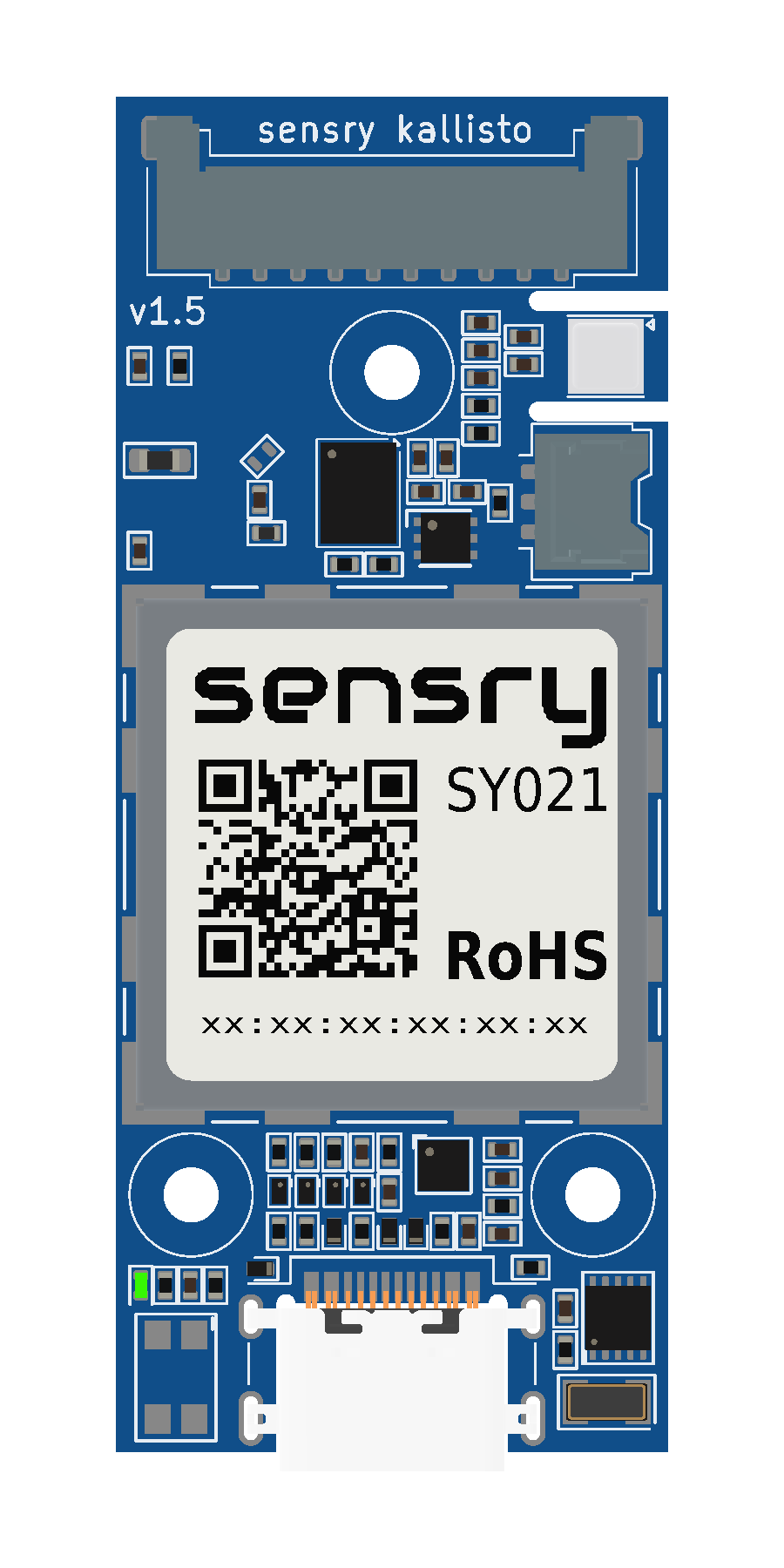 |
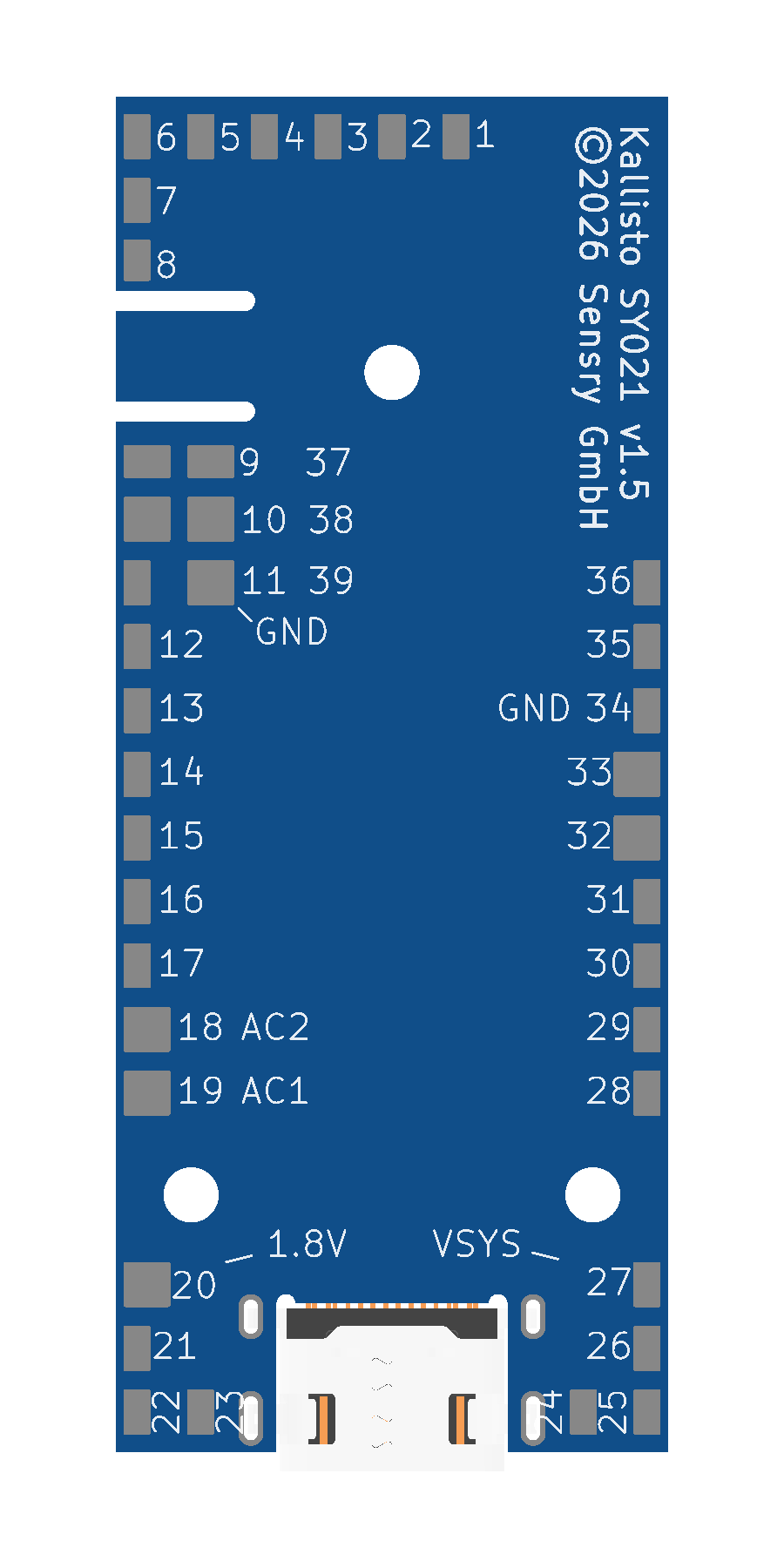 |
Features
- SoC
- nRF52840 with Bluetooth LE and an on-board antenna.
- Sensors
- Acceleration, gyroscope, magnetic field and high-frequency vibration sensing.
- Temperature, relative humidity, pressure and VOC values.
- Optical sensing and a digital MEMS microphone.
- Peripherals
- 1 Gbit (128 MiB) external flash memory and a real-time clock.
- Four low-side transistor outputs, a user LED and a reset button.
- Connectors and power
- Bottom LGA pads for carrier-board integration.
- 10-pin extension connector and USB-C connector.
- Battery connector, LiPo charging and Qi receiver circuitry for an external coil.
Programming & software support
The module is supplied with Kallisto® firmware for sensor configuration and data acquisition over Bluetooth LE. The Web Toolbox and the Android and iOS mobile apps provide access to the module. See Quick-Start for the initial connection and Ecosystem for software tools. Firmware updates for the platform module are available through the firmware update page.
Integrated Sensors
| Component | Function | Interface | Key parameters |
|---|---|---|---|
| BMI270 | 3-axis accelerometer 3-axis gyroscope |
SPI1 | Acceleration: ±2/4/8/16 g, output data rate up to 1.6 kHz. Angular velocity: ±125/250/500/1000/2000 °/s, output data rate up to 6.4 kHz. |
| LIS2MDL | 3-axis magnetometer | SPI1 | ±50 gauss; 16-bit output; continuous-mode output data rates of 10, 20, 50 or 100 Hz. |
| KX134-1211 | 3-axis accelerometer for vibration sensing | SPI3 | ±8/16/32/64 g; 16-bit output; output data rate up to 25.6 kHz. |
| BME680 | Temperature, humidity, pressure and gas sensor | I²C | Temperature: −40 to +85 °C. Relative humidity: 0–100 % RH. Pressure: 300–1100 hPa. VOC values: software processing with the Bosch BSEC library. |
| OPT3002 | Light-to-digital sensor | I²C | Spectral range: 300–1000 nm. Measurement levels: 1.2 nW/cm² to 10 mW/cm² at 505 nm. Integration time: 100 or 800 ms. |
| SPK0641HT4H-1 | Digital MEMS microphone | PDM | Mono PDM output. Typical sensitivity: −26 dBFS at 94 dB SPL and 1 kHz in low-power mode. |
The key parameters describe the capabilities of the individual sensor ICs, rather than firmware sampling or Bluetooth streaming rates. Available settings and data rates depend on the firmware and its configuration.
Measurement characteristics
The following values describe the sensor ICs, not the accuracy of the complete board or the output rate of Kallisto® firmware. Available ranges, rates and processed outputs depend on firmware configuration. Typical values are marked typ.; accuracy figures apply under the stated conditions.
Measurement overview
| Measurand | Component | Range / response |
|---|---|---|
| Acceleration, x/y/z | BMI270 | ±2 / ±4 / ±8 / ±16 g |
| Angular velocity, x/y/z | BMI270 | ±125 / ±250 / ±500 / ±1,000 / ±2,000 °/s |
| Magnetic field, x/y/z | LIS2MDL | Nominal ±50 gauss |
| Vibration acceleration, x/y/z | KX134-1211 | ±8 / ±16 / ±32 / ±64 g |
| Temperature | BME680 | −40 to +85 °C |
| Relative humidity | BME680 | 0–100 %RH, non-condensing |
| Ambient pressure | BME680 | 300–1,100 hPa |
| Gas resistance / VOC response | BME680 | Resistance in Ω; no selective gas-concentration range |
| IAQ (derived) | BME680 + BSEC | 0–500 air-quality index |
| eCO₂ (derived) | BME680 + BSEC | CO₂-equivalent in ppm |
| bVOC (derived) | BME680 + BSEC | Breath-VOC equivalent in ppm |
| Optical irradiance | OPT3002 | 1.2 nW/cm² to 10.064 mW/cm² at 505 nm; spectral response 300–1,000 nm |
| Raw audio | SPK0641HT4H-1 | 20 Hz–20 kHz response; 120 dB SPL overload typ. at 10% THD, 1 kHz |
IAQ, eCO₂ and bVOC require the Bosch BSEC library. These values are calculated from the BME680 measurements; they are not direct VOC or CO₂ concentration measurements. Availability depends on the firmware's BSEC integration. See the BME680 details below.
Resolution, accuracy and output formats
BMI270 — acceleration and angular velocity
Source: BMI270 datasheet.
| Parameter | Acceleration | Angular velocity |
|---|---|---|
| Hardware output data rate | Normal: 12.5–1,600 Hz; low power: 0.78–400 Hz | Normal/performance: 25–6,400 Hz; low power: 25–100 Hz |
| Sensitivity, in ascending range order | 16,384 / 8,192 / 4,096 / 2,048 LSB/g | 262.144 / 131.072 / 65.536 / 32.768 / 16.384 LSB/(°/s) |
| Gain error | ±0.4% at ±8 g | ±2%; ±0.4% after component retrimming (CRT) |
| Zero offset at 25 °C | ±20 mg | ±0.5 °/s |
| Output | 16 bits/axis | 16 bits/axis |
LIS2MDL — magnetic field
Source: LIS2MDL datasheet.
| Parameter | Value / condition |
|---|---|
| Hardware output data rate | 10 / 20 / 50 / 100 Hz |
| Digital range | ±49.152 gauss; nominal ±50 gauss |
| Sensitivity | 1.5 mgauss/LSB (0.15 µT/LSB) |
| Sensitivity tolerance | ±7% |
| Offset with offset cancellation | ±60 mgauss at 25 °C, 2.5 V |
| Output | 16 bits/axis |
The offset test voltage differs from the board's nominal 1.8 V supply.
KX134-1211 — vibration acceleration
Source: KX134-1211 specifications, Rev. 4.0, tables 1–2. Unless stated otherwise, these IC specifications apply at 2.5 V and 25 °C.
| Parameter | Value / condition |
|---|---|
| Measurement ranges | ±8 / ±16 / ±32 / ±64 g |
| Output data rate | Up to 25.6 kHz |
| Sensitivity, 16-bit mode, in ascending range order | 4,096 / 2,048 / 1,024 / 512 counts/g typ. |
| Sensitivity min.–max., same range order | 3,768–4,424 / 1,884–2,212 / 942–1,106 / 471–553 counts/g; tolerance at ±1 g stimulus |
| Zero-g offset | ±75 mg typ.; ±175 mg max. |
| Sensitivity temperature variation | 0.01%/°C typ. |
| Zero-g offset temperature variation | 0.5 mg/°C typ. |
| Non-linearity | 0.6% of full scale typ. |
| Cross-axis sensitivity | 2% typ. |
| Mechanical −3 dB bandwidth | x: 8.2 kHz; y: 8.5 kHz; z: 5.6 kHz typ., at 25.6 kHz ODR and LPRO = 1 |
| Output | 16 bits/axis; optional 8-bit buffer mode |
Effective bandwidth depends on the output data rate and filter settings. The manufacturer's 2.5 V test condition differs from the module's nominal 1.8 V sensor supply; these figures are not module-level accuracy guarantees.
BME680 — temperature, humidity, pressure and gas response
Source: BME680 datasheet.
| Measurand | Resolution | Accuracy / condition | Raw output |
|---|---|---|---|
| Temperature | 0.01 °C API step | ±0.5 °C at 25 °C; ±1 °C over 0–65 °C | 20-bit register; 16–20 useful bits |
| Humidity | 0.008 %RH | ±3 %RH at 25 °C, 20–80 %RH, including hysteresis | 16 bits |
| Pressure | 0.18 Pa at highest oversampling | Absolute ±0.6 hPa over 0–65 °C; relative ±0.12 hPa over 700–1,100 hPa, 25–40 °C, constant RH | 20-bit register; 16–20 useful bits |
| Gas resistance | 0.08% relative resolution typ. | No universal VOC concentration accuracy | 10-bit ADC + 4-bit range code |
Derived outputs — Bosch BSEC library required
| Output | Range / meaning | Resolution / accuracy | Format |
|---|---|---|---|
| IAQ | 0–500 air-quality index | 1 index point; algorithm and test-condition dependent | BSEC software output |
| eCO₂ | CO₂-equivalent in ppm | Algorithm-dependent; no direct CO₂ measurement accuracy | BSEC software output |
| bVOC | Breath-VOC equivalent in ppm | Algorithm-dependent; no universal concentration accuracy | BSEC software output |
These outputs require the Bosch BSEC library integrated into the firmware. They are calculated from sensor measurements, not direct VOC or CO₂ concentration measurements. LP updates every 3 s; ULP every 300 s. Availability depends on the BSEC version and firmware configuration.
Temperature, pressure and humidity share a conversion cycle. Timing depends on enabled measurements, oversampling and heater settings; useful temperature and pressure bits depend on oversampling. The temperature reading includes PCB temperature and sensor self-heating.
Measurement timing
The BME680 uses host-triggered measurements; conversion time depends on oversampling and heater duration. BSEC defines the following update intervals (BME680 datasheet, section 4.1, table 17):
| BSEC mode | Temperature, pressure and humidity | Gas / IAQ update interval |
|---|---|---|
| Ultra-low power (ULP) | 300 s | 300 s |
| Quick ultra-low power (q-ULP) | 3 s | 300 s |
| Low power (LP) | 3 s | 3 s |
| Continuous (CONT), testing only | 1 s | 1 s |
CONT is intended for short-term testing. These intervals describe BSEC operating modes, not a guaranteed board output rate. Firmware must follow the scheduling of its BSEC version and configuration; a 10 s interval is not one of the modes listed in the datasheet.
OPT3002 — optical irradiance
Source: OPT3002 datasheet.
| Parameter | Value / condition |
|---|---|
| Resolution | 1.2 × 2ᴱ nW/cm²/LSB; exponent E = 0–11 |
| Integration time | 100 / 800 ms; approximately 9.7 / 1.25 samples/s |
| Linearity | 2% above 5,000 nW/cm²; 5% below |
| Range matching | 0.2% typ. |
| Output | 12-bit mantissa + 4-bit exponent; 23-bit dynamic range |
The finest resolution requires 800 ms integration. Automatic range changes and conversion timing affect the effective rate.
SPK0641HT4H-1 — raw audio
Source: SPK0641HT4H-1 datasheet.
| Parameter | Value / condition |
|---|---|
| PDM clock frequency | Performance: 1–4.8 MHz; low power: 0.35–0.8 MHz |
| Sensitivity | −26 dBFS at 94 dB SPL, 1 kHz |
| Sensitivity tolerance | ±1 dB |
| Signal-to-noise ratio | 64.5 dB(A) typ., performance mode |
| Output | 1-bit PDM |
Sensitivity conditions: 1.8 V supply, 768 kHz PDM clock, 23 ±2 °C and 55 ±20 % relative humidity. PDM clock frequency is not the PCM sample rate. Decimation, PCM sample rate and word length are set by firmware.
SoC and peripherals
| Component | Function |
|---|---|
| nRF52840 | 64 MHz Arm Cortex-M4F SoC with Bluetooth LE, 1 MB internal flash and 256 KB RAM. |
| W25Q01NWZEIM | 1 Gbit (128 MiB) external serial flash on SPI2, including the additional Quad SPI data lines. |
| PCF85263ATL | I²C real-time clock with battery backup. Its interrupt output is connected to SHPHLD. |
| nPM1100 | Power management, battery charging, system power path and the 1.8 V buck supply. |
| BQ51013BRHL | Qi wireless-power receiver and USB input-source control. |
| CSD13381F4 | Four low-side switching outputs EXT0–EXT3 on the LGA pads. |
System Block Diagram

SPI1, I²C and PDM signals are shared with on-board devices. In particular, PDM_DATA is driven by the on-board microphone; an external device must not drive the same data slot. The low-side outputs switch a load towards ground and do not supply a positive output voltage.
Technical Data
Mechanical Parameters
| Parameter | Value |
|---|---|
| Board construction | Bottom LGA pads with top-side component assembly |
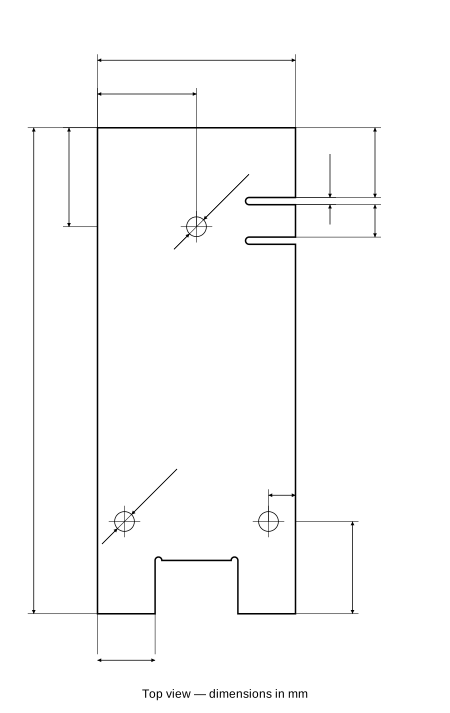
| PCB outline, length × width × height | 54 mm × 22 mm × 5 mm |
| Mounting holes | Three holes, Ø2.2 mm |
| Battery connector | Molex 78171-0003, 3 pins |
| Extension connector | Molex 504050-1091, 10 pins |
| Radio antenna | On-board chip antenna |
| User controls | Reset button and user LED |
LGA Pinout
The following drawing is a top view of the PCB with the bottom LGA pads projected onto it. Signal directions in the table are relative to the module. Logic signals use the nominal 1.8 V domain unless another domain is listed.
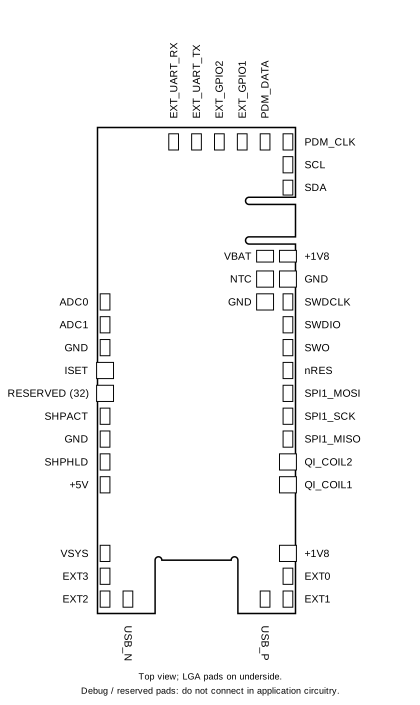
| Pad | Signal | Direction / type | Domain | Function / restrictions |
|---|---|---|---|---|
| 1 | EXT_UART_RX | Input | 1.8 V logic | UART receive; shared with extension connector pin 10. |
| 2 | EXT_UART_TX | Output | 1.8 V logic | UART transmit; shared with extension connector pin 9. |
| 3 | EXT_GPIO2 | I/O | 1.8 V logic | GPIO; shared with extension connector pin 8. |
| 4 | EXT_GPIO1 | I/O | 1.8 V logic | GPIO; shared with extension connector pin 7. |
| 5 | PDM_DATA | Input to SoC | 1.8 V logic | Shared with the on-board microphone and extension connector pin 6. |
| 6 | PDM_CLK | Output | 1.8 V logic | Shared microphone clock; extension connector pin 5. |
| 7 | SCL | I/O | 1.8 V logic | Shared I²C clock; extension connector pin 4. |
| 8 | SDA | I/O | 1.8 V logic | Shared I²C data; extension connector pin 3. |
| 9 | +1V8 | Power output | 1.8 V | Regulated module supply rail. |
| 10 | GND | Ground | Ground | Common ground. |
| 11 | SWDCLK | Debug | 1.8 V logic | Reserved for programming/debugging; do not connect in application circuitry. |
| 12 | SWDIO | Debug | 1.8 V logic | Reserved for programming/debugging; do not connect in application circuitry. |
| 13 | SWO | Debug | 1.8 V logic | Reserved for programming/debugging; do not connect in application circuitry. |
| 14 | nRES | Input | 1.8 V logic | Active-low system reset; shared with the reset button. |
| 15 | SPI1_MOSI | Output | 1.8 V logic | Shared SPI1 controller data output. |
| 16 | SPI1_SCK | Output | 1.8 V logic | Shared SPI1 clock. |
| 17 | SPI1_MISO | Input | 1.8 V logic | Shared SPI1 controller data input. |
| 18 | QI_COIL2 | Coil connection | Qi receiver input | Receiver-coil terminal 2. |
| 19 | QI_COIL1 | Coil connection | Qi receiver input | Receiver-coil terminal 1. |
| 20 | +1V8 | Power output | 1.8 V | Same regulated rail as pad 9. |
| 21 | EXT0 | Low-side output | Load circuit | Switched connection towards ground, channel 0. |
| 22 | EXT1 | Low-side output | Load circuit | Switched connection towards ground, channel 1. |
| 23 | USB_P | I/O | USB | USB D+; shared with USB-C connector. |
| 24 | USB_N | I/O | USB | USB D−; shared with USB-C connector. |
| 25 | EXT2 | Low-side output | Load circuit | Switched connection towards ground, channel 2. |
| 26 | EXT3 | Low-side output | Load circuit | Switched connection towards ground, channel 3. |
| 27 | VSYS | Power output | System rail | PMIC system supply; shared with extension connector pin 2. Do not supply this pad externally. |
| 28 | +5V | Power input / shared rail | Nominal 5 V | Charger input rail, also supplied by the USB input switch or Qi receiver. |
| 29 | SHPHLD | Control input | PMIC; VBAT pull-up | Active-low wake input; shared with the RTC interrupt output. |
| 30 | GND | Ground | Ground | Common ground. |
| 31 | SHPACT | Control | 1.8 V logic | Ship-mode activation; shared with an internal SoC output. |
| 32 | RESERVED | — | — | Do not connect. |
| 33 | ISET | Internal control output | 1.8 V logic | PMIC input-current selection; not a general-purpose I/O. |
| 34 | GND | Ground | Ground | Common ground. |
| 35 | ADC1 | Analog input | SoC analog input | Connected to nRF52840 AIN4 / P0.28. |
| 36 | ADC0 | Analog input | SoC analog input | Connected to nRF52840 AIN0 / P0.02. |
| 37 | VBAT | Battery power | Battery rail | Battery positive; shared with battery connector pin 1. |
| 38 | BAT_NTC10K | Analog input | Battery-temperature circuit | Battery 10 kΩ NTC; shared with battery connector pin 2. |
| 39 | GND | Ground | Ground | Common ground; shared with battery connector pin 3. |
Electrical Parameters
The nPM1100 generates the nominal 1.8 V rail for the SoC, sensors, memory and RTC main supply. VSYS is the separate system rail and follows the active power path; it is not the regulated 1.8 V output. The extension connector supplies VSYS, while the bottom LGA exposes both rails.
Board Power & Battery Charge
A 150 mAh or 500 mAh battery can be ordered together with the module. Other battery capacities can be ordered on request.

| Supply path | Connection | Use |
|---|---|---|
| USB-C | USB-C connector | Module power and battery charging. |
| External 5 V | LGA pad 28 (+5V) and ground | Shared charger-input supply. |
| Battery | Battery connector or LGA pads 37–39 | Module power without external input. |
| Qi | Receiver coil on LGA pads 18–19 | Charger input via BQ51013B. |
The module can operate from USB-C with or without a battery. The USB input switch and Qi receiver feed the common +5V rail upstream of the nPM1100. The BQ51013B selects the wired USB source when it is present. Its AD-EN output controls the USB input switch.
Current selection and source control
| Signal / configuration | Function |
|---|---|
| ISET low | Nominal PMIC input-current limit: 100 mA. A pull-down establishes this state when the SoC does not drive the signal. |
| ISET high | Nominal PMIC input-current limit: 500 mA. Firmware must select this only when the connected source permits it. |
| ICHG configuration | Charger-current setting: 400 mA. Actual battery current also depends on the input-current limit, system load and thermal regulation. |
ISET selects an input limit, not a guaranteed battery charge current.
Qi receiver coil
Connect the receiver coil to QI_COIL2 and QI_COIL1, LGA pads 18 and 19. The coil specified in the hardware design is the TDK WR222230-26M8-G. Its placement and coupling to the transmitter are part of the mechanical integration. The receiver coil can be ordered together with the module.

Battery Interface
A 150 mAh or 500 mAh battery is available as an option when ordering the module. Other battery capacities can be ordered on request.
Use a protected single-cell LiPo battery with a 10 kΩ temperature-sensing NTC. The battery must be suitable for the configured charging current. The battery connector is Molex 78171-0003; the same signals are available on the LGA pads.
| Battery connector pin | Signal | LGA pad |
|---|---|---|
| 1 | VBAT — battery positive | 37 |
| 2 | Battery NTC | 38 |
| 3 | GND — battery negative | 39 |
The RTC backup supply is connected to VBAT independently of the main 1.8 V rail.
Extension Interface
The 10-pin Molex Pico-Lock connector 504050-1091 exposes the signals below. Directions are relative to the module; digital signals use the nominal 1.8 V domain. The I²C and PDM connections share their on-board sensor buses.
| Pin | Signal | Direction / type | Domain | Function |
|---|---|---|---|---|
| 1 | GND | Ground | Ground | Common ground. |
| 2 | VSYS | Power output | System rail | PMIC system supply; do not supply externally. |
| 3 | SDA | I/O | 1.8 V logic | Shared I²C data. |
| 4 | SCL | I/O | 1.8 V logic | Shared I²C clock. |
| 5 | PDM_CLK | Output | 1.8 V logic | Shared microphone clock. |
| 6 | PDM_DATA | Input to SoC | 1.8 V logic | Shared microphone data. |
| 7 | EXT_GPIO1 | I/O | 1.8 V logic | GPIO; also LGA pad 4. |
| 8 | EXT_GPIO2 | I/O | 1.8 V logic | GPIO; also LGA pad 3. |
| 9 | EXT_UART_TX | Output | 1.8 V logic | UART transmit. |
| 10 | EXT_UART_RX | Input | 1.8 V logic | UART receive. |
Ship Mode Activation / Deactivation
Ship mode isolates the battery from the PMIC system power path for transport or storage. It does not disconnect the RTC backup supply from the battery.
| Action | Conditions / signal |
|---|---|
| Enter ship mode | Remove external input power. Hold SHPACT high, at least 1.1 V, for at least 200 ms. Firmware can also drive the internally connected SHPACT signal. |
| Leave ship mode through SHPHLD | Hold SHPHLD low, at most 0.4 V, for at least 200 ms. The RTC interrupt shares this signal. |
| Leave ship mode through input power | Apply power to the PMIC input, for example through USB-C. |

For development and programming support, contact support@sensry.de.